Write Family Photo Captions That Preserve What Is Known
A strong family-photo caption adds information the picture cannot supply and makes its uncertainty visible. Identify people in a stated order, distinguish the event date from a later scan date, and keep the evidence behind the wording in a private record. A short accurate caption is more useful than a detailed story built on guesses.
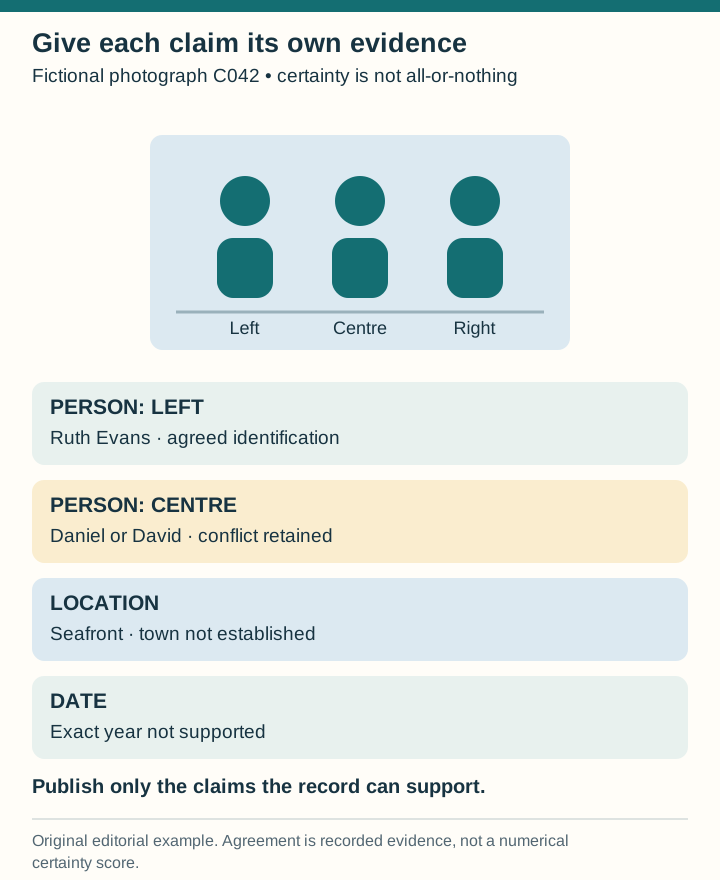
Captions also need an editorial purpose. A family-history volume may need full names and relationships. A recent yearbook may need only the event and place. Decide who will read the book without its maker beside them, then supply the information that reader would otherwise miss.
Separate observation, identification and interpretation
A photograph can show three people outside a doorway. Their names may come from a relative; the occasion may come from a letter; the claim that they were celebrating a promotion may be an interpretation. Write those layers separately before producing the final sentence.
The Library of Congress's photograph-analysis approach distinguishes observable details, interpretations and questions for further investigation. That distinction works well here: record what can be seen, then ask what evidence supports the identity or event. Clothing and apparent age can suggest a line of inquiry, but should not manufacture a precise year by themselves.
| Evidence available | Useful published wording | Private note to retain |
|---|---|---|
| A dated invitation and identified guests | Mara and Luis at Elena's wedding, 12 June 1976 | Invitation reference and who identified the people |
| One relative recalls the place but not the year | Probably at the family house in Bristol; date unknown | Name of the person recalling the location and interview date |
| Two relatives disagree about the person | Unidentified portrait from the Patel family collection | Both proposed identifications, separately attributed |
| Only a modern scan timestamp exists | Family gathering; original date unknown | Scan date recorded as digitization, not the event date |
Ask questions that do not supply the answer
Begin with “What do you remember about this photograph?” rather than “That must be your brother at the 1968 picnic, isn't it?” A leading question can replace a person's recollection with the suggestion in the question. Show a numbered copy and allow the person to identify what matters before narrowing the discussion.
Agree whether you may record the conversation and how its words may be used. Oral History Association guidance emphasizes informed participation, an opportunity for review and attention to agreed access. In a family album, a practical application is to send the intended caption or quotation to the contributor before it is printed.
- Identity: Which person are you identifying, and where are they in the frame?
- Basis: Were you there, did someone tell you, or do you recognize another clue?
- Time: What makes that date or date range plausible?
- Limits: Which details are uncertain, and what should remain private?
Record the conversation date separately from the historical event. “Recalled by Nadiya, November 2026” describes the source of a statement, not when the photograph was taken. A later correction should be added to the record with its reason; do not silently remove the earlier attribution.
Make names and relationships unambiguous
Specify “left to right” when listing people across a single row. For a group with several rows, describe the rows or use a small numbered identification key. A five-name sentence without a position rule can attach the correct names to the wrong faces.
Keep the name used at the time and a later name when that distinction helps recognition. Do not force every possible surname into every caption. A first appearance can provide the fuller identification; an index or family note can handle additional relationships. Confirm diacritics and preferred spelling with a knowledgeable person.
For the fictional photograph C042, suppose two contributors agree that the leftmost person is Ruth, but one calls the central person Daniel and another calls him David. The final caption can name Ruth and leave the central figure unidentified. Confidence is attached to each claim, not awarded to the entire image as a single score.
| Claim | Status | Publication decision |
|---|---|---|
| Left: Ruth Evans | Agreed by two named contributors | Use the name, retaining the evidence record |
| Centre: Daniel or David | Conflicting identifications | Leave unnamed or state uncertainty explicitly |
| Location: seafront | Visible setting; town unknown | Use “at the seafront,” without inventing a town |
| Year: 1954 | No supporting record located | Do not print the precise year |
Keep the printed caption connected to the file
IPTC metadata provides distinct fields for descriptions, people, creation dates and locations. Software support varies, so a separate inventory remains useful. Give each image a stable ID and store its approved caption there; embedded descriptions can then supplement that record without becoming the only copy.
Do not enter an invented 1 January merely because a date field insists on a complete date. Keep an approximate year or range in a suitable text field and explain the uncertainty. If you adjust a camera timestamp, record the reason and preserve the original information where possible.
The inherited-photo sorting guide explains object IDs. Use them when a scan shows the reverse as well as the front: C042-front and C042-back belong to the same object, but only one may appear on the album page.
Edit for useful information and readable length
Remove phrases such as “a beautiful moment to remember” when they displace names, context or a specific memory. Compare “A wonderful summer” with “Ruth teaching Daniel to mend the fishing net, summer 1982.” The latter gives the reader an action and relationship. It should be used only if those details are supported.
Do not invent a participant's feelings from their facial expression. A caption can say that someone is smiling. A contributor's recollection of feeling relieved can be attributed to that person. These are different statements, and neither needs an exaggerated emotional explanation.
Proof captions in their final positions
Review names and dates against the inventory first, then against the placed pictures. A technically correct caption can drift onto the wrong image during layout changes. Read captions at actual page size and check that their order follows the pictures naturally.
For a memorial album, let contributors review their attributed recollections. For an annual family book, capture the wording while the events are still familiar. Retain the approved caption list with the final layout so a future reprint does not require another round of guesses.