Digitize Negatives and Slides With a Traceable Project Brief
Before sending negatives or slides for digitization, identify the groups, preserve their sequence and agree what the operator will return. A useful brief specifies image coverage, orientation, file versions and the link between each frame and its original holder. It does not choose a service solely by the largest advertised scan resolution.
Film requires light to pass through it; a print is normally viewed by reflected light. A service equipped for ordinary prints may not have the holders, capture method or experience for your particular film. Start with a small documented pilot, especially when the material's type or condition is uncertain.
Describe what you actually have
Count slide mounts, negative strips and individual frames separately. A box containing ten strips is not necessarily ten photographs. Note the visible dimensions, whether images appear positive or negative, existing frame numbers and all container labels. Do not cut strips or remove mounts merely to make them fit a new storage system.
The Canadian Conservation Institute distinguishes several plastic film bases and their different deterioration problems. Acetate can deteriorate with distortion and a vinegar-like odour; nitrate presents additional hazards. Identification is a specialist task when uncertain. Do not use a flame, solvent or improvised destructive test to decide what a family collection contains.
| Record | Fictional example | Why the operator needs it |
|---|---|---|
| Container and sequence | Tray T03, positions 001–080 | Return files can preserve the original order |
| Physical format | Mounted transparencies; mount dimensions measured | Holder and capture compatibility need confirmation |
| Condition observation | Two mounts warped; one frame cracked | Routine loading may be unsuitable |
| Requested use | Album images up to 6 × 9 inches | The intended output informs the capture proposal |
Keep the sequence even if it tells an imperfect story
A slide tray may reflect a presentation made decades after the photographs were taken. Preserve that order as an arrangement, not as proof of chronology. The number T03-014 should continue to identify position 14 even if later research shows that it belongs before T03-006 in the new book.
Photograph labelled boxes and trays before dispatch and keep a manifest of the groups. Where the operator must transfer material into different holders, agree how the mapping will be maintained. The album can reorder selected images; the capture record should explain how to find their originals.
Ask for a pilot that reveals the real compromises
Include representative frames rather than only the easiest bright landscape. A useful fictional pilot contains a pale portrait, a dense interior, fine distant detail and a frame with a visible surface defect. Ask how the operator handles each and what interventions require approval.
Separate faithful capture from presentation correction. A negative requires interpretation to produce a positive image, but strong color changes, sharpening and repair should still be understandable. Request a reference version and an album-ready version if you need both, with the operator explaining the difference rather than simply labelling everything “restored.”
| Feature | What to inspect | What to agree |
|---|---|---|
| Frame coverage | Image boundaries and any crop | Whether the full image area or a chosen crop is delivered |
| Orientation | Signs, known objects and trusted references | How mirrored or rotated images are identified |
| Tone and color | Faces, highlights and shadows across several frames | How far automatic or manual corrections may go |
| Defect treatment | Dust, scratches and fine image detail | Whether correction is process-compatible and reversible through retained versions |
A mirror-image scan can look plausible when no text is visible. Use a reliable reference where available, and ask the operator to identify the intended viewing orientation. Do not flip a photograph simply because a relative remembers a room differently; memory may be the uncertain part.
Model the delivery before ordering it
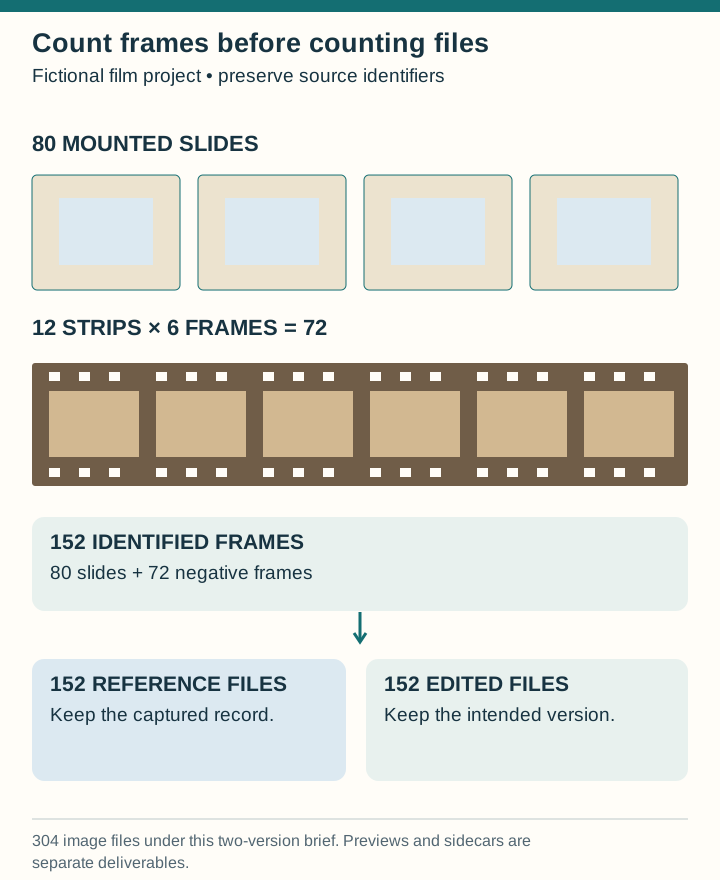
Suppose a collection has 80 mounted slides and 12 strips containing 6 frames each. That is 152 frames: 80 + 72. If every frame receives one reference file and one corrected file, the expected image deliverables are 304 files, excluding inventories, previews or metadata sidecars.
If the operator returns 304 files, you still need to verify their pairing. Two versions of one frame do not compensate for a missing frame elsewhere. A manifest should associate each original ID with the relevant delivered filenames and any exception: not captured, damaged, duplicate capture, or awaiting review.
The count is an original planning example, not a typical service package. Some workflows return one file per frame; others provide more. The important step is agreeing the expected types before interpreting a folder total.
Treat condition problems as a separate workstream
Warping, stickiness, unusual odour, mould or damaged image layers call for advice before routine transport or scanning. CCI emphasizes that cold storage can help sensitive photographic materials but requires appropriate packaging and acclimatization. A home freezer is not a complete preservation system.
Describe an observation without making an unsupported diagnosis: “three strips appear curled and the envelope has an unusual odour” is more useful than “the whole collection is nitrate.” Send reference photographs of containers or damage if the specialist requests them, and follow their handling and shipping instructions for the actual material.
- Do not clean film with household fluids.
- Do not flatten it under heavy objects or heat.
- Do not discard original mounts before their inscriptions and positions are recorded.
- Do not assume a successful scan stops deterioration of the original.
Review the images as a collection
Inspect contact sheets for sequence, missing frames and repeated filenames, then open selected full files for detail and all files flagged as problematic. Compare captions and date assumptions with the original enclosures. The caption guide helps distinguish the date on a processing envelope from the date of an event.
Use stable collection identifiers to keep the returned images findable. If the collection also includes ordinary prints, brief that work separately using the print-scanning guide. A good delivery preserves both a usable image and a traceable route back to the physical source.