Store and Handle Photo Albums With Proper Support
Store a photo album where its weight is supported and where light, damp, heat and handling are controlled. A suitable box helps, but the room, shelf and way the album is used matter too. Check older albums before adding enclosures or moving photographs; a fragile binding or stuck print can require specialist advice.
The useful starting point is an observation of the whole object. A modern printed book, a heavy mounted album and a historical scrapbook with loose inserts do not behave identically. Record what you have and choose a housing and handling arrangement that supports its actual structure.
Choose the location before buying a box
The U.S. National Archives recommends keeping family material away from damp basements, hot attics, leaks, food and water, and storing it on shelving rather than the floor. These are practical risk reductions. A box placed under a leaking pipe remains under a leaking pipe.
Look at the proposed location during ordinary use. Does sunlight reach the shelf? Is it next to a radiator, exterior damp patch or plumbing? Can the album be removed without sliding other heavy objects across it? A convenient, stable location is more useful than a theoretically suitable shelf that nobody can access carefully.
| Observation | Why it matters | Practical response |
|---|---|---|
| Direct sun crosses the shelf | Light reaches exposed material and may heat it | Choose a protected location and limit display exposure |
| A pipe or known leak is overhead | A local failure can wet the collection | Relocate and address the building problem |
| The album overhangs the shelf | Part of its weight lacks support | Use an adequately sized shelf or housing arrangement |
| Retrieval requires moving a tall stack | Every use becomes a handling operation | Reduce stacking and make access easier |
Support the album as an object
National Archives guidance for bound collections advises storing scrapbooks and albums flat, preferably boxed, with support for their structure and loose contents. This is especially relevant to heavy, bulky or fragile volumes. Do not force a swollen album closed merely to make it fit a standard container.
Measure the object as it rests comfortably, including projecting covers or hardware. Then check the enclosure's internal dimensions, not only the product's outside measurements. Allow for protective supports specified for the object and for removal without gripping a fragile edge.
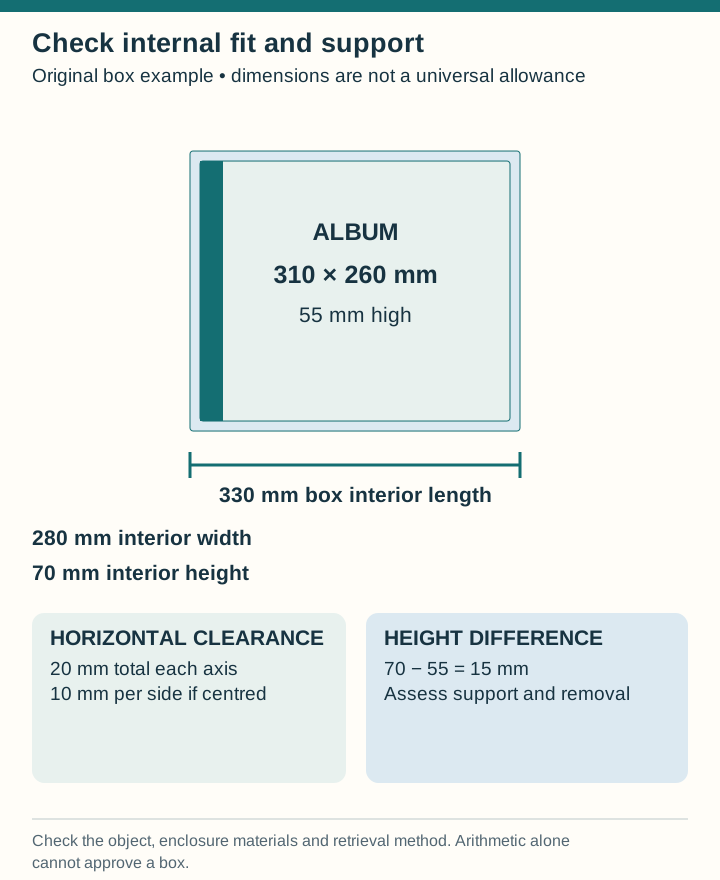
Consider a fictional album measuring 310 × 260 × 55 mm. A candidate box with internal dimensions 330 × 280 × 70 mm provides 20 mm total length clearance, 20 mm width clearance and 15 mm height clearance. That is 10 mm on each side when centred horizontally, not 20 mm on each side. The arithmetic does not by itself establish that the box is appropriate.
| Dimension | Album | Box interior | Total difference |
|---|---|---|---|
| Length | 310 mm | 330 mm | 20 mm |
| Width | 260 mm | 280 mm | 20 mm |
| Height | 55 mm | 70 mm | 15 mm |
A much larger box can permit movement; a tight box can abrade covers or make retrieval difficult. Ask the enclosure supplier or a conservator how the particular object should be supported. A custom fit can be more suitable than adding arbitrary stuffing to an oversized container.
Check material claims at the relevant level
For materials in contact with photographs, ask about photo suitability and the Photographic Activity Test rather than relying on “archival” alone. The Library of Congress also cautions that different photographic processes need appropriate handling and enclosures. A claim about an outer box does not establish that every sleeve, adhesive or inserted sheet is suitable.
Do not improve an old album by adding large amounts of interleaving without considering the binding. Extra thickness can change how the volume closes. Nor should you remove adhered photographs as a routine storage step. The National Archives specifically advises against separating a photograph attached to an album page without appropriate treatment.
If a loose original needs separate housing, retain its album and page association. The record should explain where it came from and where it now lives. The collection sorting guide provides a simple identification approach.
Make careful use easy
Bring the album to a clean, dry table with enough space for the open object and its supports. Move the whole album rather than pulling it by a projecting spine or decoration. Open only as far as its structure comfortably allows, and support covers or pages when needed.
- Keep food, drinks and hand lotion away from the viewing area.
- Turn pages gently and support heavy leaves.
- Keep loose items in their recorded positions or identified housings.
- Stop if opening causes cracking, detachment or resistance.
A frequently used family copy can take pressure off an irreplaceable original. For capture, follow the digitization guidance and use supported camera copying when a bound object cannot safely lie flat. Digitization creates another way to view the information; it does not repair the original.
Keep a brief condition record
Record a few consistent observations: cover attachment, page edges, loose inserts, sticking and any new spots or distortion. Take reference photographs without forcing the object open. A comparison is more useful when the images show the same areas under similar conditions.
Use descriptive language. “The lower cover corner is lifted by about 3 mm compared with the earlier photograph” is clearer than “the album is deteriorating badly.” An observation should lead to a next action, such as changing support or obtaining advice, rather than becoming a diagnosis made from a photograph alone.
Respond to a problem without making it harder to treat
If an album is wet, mouldy, stuck or visibly shedding material, stop ordinary use and seek prompt advice from a photograph or book conservator about that object. Do not apply heat, household cleaners or improvised adhesive repairs. Do not pull apart pages to discover whether they can still be separated.
For display, the National Archives recommends using reproductions where possible because both visible and ultraviolet light can change originals. A closed storage copy and a separate display copy can have different jobs. The print comparison guide helps prepare that reproduction without presenting it as the historical original.
End each use by returning the album and its record to their assigned locations. Good care is a repeatable arrangement: the object is supported, its environment is understood, and the next person knows how to handle it without having to invent a method.