Sort Inherited Photographs Without Losing Their History
Start an inherited photograph collection by recording how it arrived, keeping existing groups together and giving each group a stable identity. Do not begin by arranging every picture into a new family tree. The envelope, album sequence and handwriting may explain relationships that disappear when the photographs are separated.
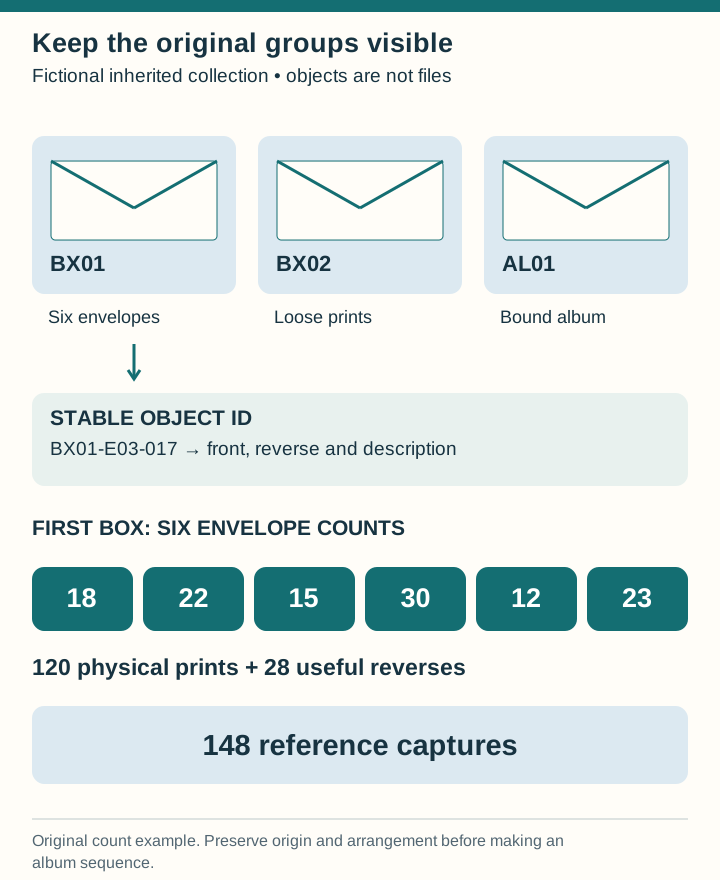
A useful first result is modest: you can find an object again, say where it came from and distinguish what is known from what still needs investigation. Selecting attractive pictures for an album comes later. This guide uses a fictional three-box collection to show how that first pass can work without turning a kitchen table into a permanent sorting station.
Record the collection before rearranging it
Photograph the containers and their labels before unpacking. Write down who supplied them, when they arrived and what that person said about their earlier ownership. Keep a statement such as “these were in Aunt Mira's cupboard” separate from the stronger claim that Mira took every photograph. Custody, authorship and the people shown are different relationships.
The archival principle of provenance keeps records from different creators or origins distinguishable. Original order can also carry meaning. For a family project, that means preserving the relationship between a labelled envelope and its contents even if a later album arranges selected reproductions chronologically. You can create a new reading order without erasing the old arrangement.
| Group ID | What arrived | Record before changing anything |
|---|---|---|
| BX01 | A shoebox containing six envelopes | Envelope order, exact labels and who supplied the box |
| BX02 | Loose prints in no obvious sequence | Current grouping and any clusters with matching handwriting |
| AL01 | A bound album with captions | Cover, page sequence, empty positions and inserted loose items |
Do not “correct” an old label by writing over it. Transcribe its wording, including uncertainty, in the record. A folder can have a new descriptive title while retaining the original title in another field. If a label says “France?”, the question mark is evidence about the earlier keeper's confidence.
Make a small, controlled workspace
Clear a dry table and remove food and drinks before bringing out originals. Support photographs and avoid touching their image surfaces. Handling guidance differs with the object and condition; clean, well-fitting gloves are appropriate for many photographs and negatives, while clumsy handling can itself cause damage. Stop when an item is stuck, brittle, flaking or otherwise difficult to move safely.
Use three working areas: the group waiting to be recorded, the object currently being described, and the completed group. Only one source group should be open at a time. This simple rule prevents two nearly identical holiday envelopes from becoming mixed while someone answers a telephone call.
- Keep the original container or a record of it with the group.
- Write temporary notes on separate paper, not on the image.
- Place uncertain items in a documented holding group rather than guessing their origin.
- Finish and close the current group before opening another.
Use identifiers that survive new discoveries
A filename such as “Grandmother-1924” becomes misleading if the identification changes. An object ID such as BX01-E03-017 remains usable: box 1, envelope 3, item 17. Store names and dates in descriptive fields. If you later discover that the portrait shows a cousin in 1928, the object, scans and notes can keep the same ID.
Numbering does not require writing directly on the original. Identify its suitable enclosure and connect the object to that enclosure through the inventory. Preserve an existing studio number or handwritten reference as a separate field; do not replace it with your own system as though it never existed.
Count objects, images and scans separately
In the fictional first box, six envelopes contain 18, 22, 15, 30, 12 and 23 loose prints: 120 physical prints. Twenty-eight have useful writing on the reverse. Capturing every front plus those reverses would produce 148 capture files before any derivatives. That is not evidence of 148 separate photographic scenes.
| Quantity | Example | What it tells you |
|---|---|---|
| Physical prints | 120 | Objects to account for and return to storage |
| Additional reverse captures | 28 | Backs selected because they contain relevant information |
| Capture files | 148 | Expected front and reverse images before editing or export |
| Distinct scenes | Not yet counted | Requires comparing duplicates and related views |
Two copies of the same scene may have different inscriptions, crops or printing histories. Keep their object identities until you have compared both sides. A visually repeated scene is not automatically a redundant object. Conversely, one album page can contain several photographs and a caption that refers to the group.
Choose the next action, not a final value judgment
Give each group one practical next action: describe, ask someone, digitize, obtain conservation advice, or leave undisturbed pending review. “Unknown” is a valid descriptive status. It should not become an automatic discard instruction.
Start identification conversations with the clearest unresolved group, perhaps a wedding set with a known location but unnamed guests. Numbered reference copies let relatives discuss the same image without repeatedly handling originals. The family caption guide explains how to record conflicting recollections rather than merging them into a false certainty.
Choose digitization priorities using both condition and usefulness. A fragile photograph may need specialist handling before capture; it is not necessarily suitable for the fastest home-scanning session. For ordinary loose prints that can be handled safely, use the scanning plan to define front, reverse and output requirements.
End each session with a collection you can understand
Before stopping, reconcile the number of physical objects with the inventory, put each group back into its identified enclosure and record any item temporarily elsewhere. Write the next task in one sentence: “Ask Sam about BX01-E03-017,” not simply “continue sorting.” A short, complete session is more useful than an ambitious rearrangement whose logic exists only in memory.
When an album selection begins, use references to object IDs instead of moving originals into a new story sequence. Your new book can show five photographs from three different envelopes while the source collection remains intelligible. Follow the storage and handling guide for the physical collection after the session. The achievement is a usable connection between object, description and location, ready for the next discovery.