Plan a Family Yearbook That Includes Ordinary Life
A family yearbook works best when it records ordinary life as well as major occasions. Set a manageable image and page budget, collect short descriptions while memories are fresh, and use a consistent monthly review. The goal is a readable account of this particular year, not equal space for every photograph taken.
A phone library naturally gives more weight to heavily photographed events. A week away may produce hundreds of images while a meaningful change at home appears in only two. Editing the yearbook is the moment to correct that imbalance without pretending that every month was equally busy.
Define the year and the people it represents
Decide whether the volume follows a calendar year, school year or another clear period. Put that range in the working brief. If the family moved in September, a school-year structure may tell the transition more naturally than splitting it between two calendar volumes.
Name the intended contributors and readers. A book for one household has a different scope from a volume shared across several households. Ask what each participant wants remembered, including people who rarely take photographs or appear in them. Participation can be a short description or a picture of an object, not only a posed portrait.
The Library of Congress's personal-photo guidance begins with locating photographs, choosing important ones and describing the selected collection. For a yearbook, apply that principle through a small recurring selection, while keeping the broader source archive separate. Album rejection is not an instruction to delete the source.
Use an image budget to expose trade-offs
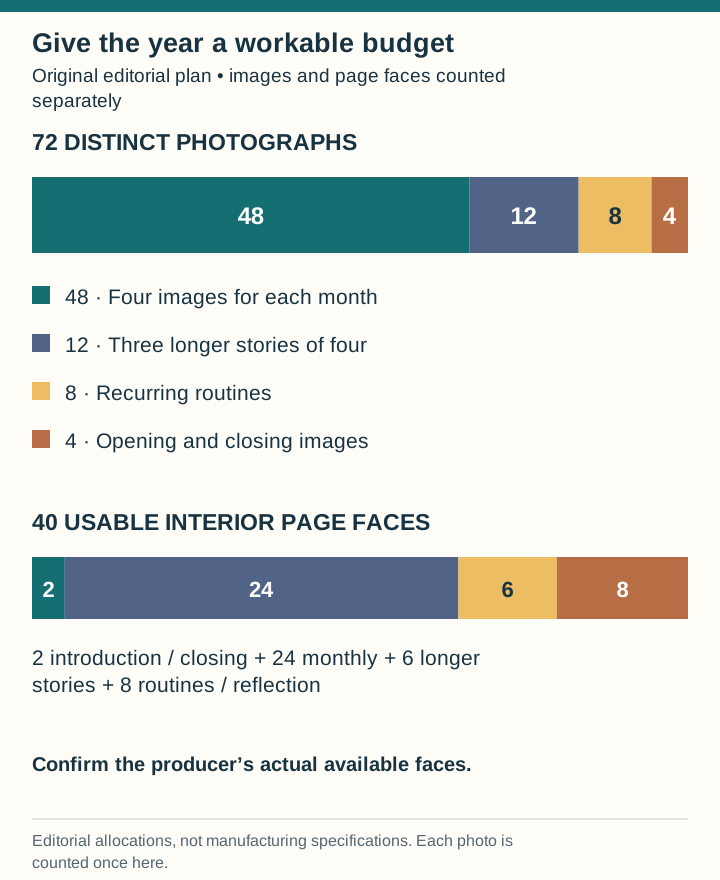
Consider an original plan for 72 photographs. Reserve 48 for twelve monthly selections of four, 12 for three longer stories of four, 8 for recurring routines and 4 for opening and closing images. These categories are editorial slots, not technical limits imposed by a printer.
| Section | Allocation | Purpose |
|---|---|---|
| Monthly selections | 12 × 4 = 48 | Keep the whole year visible |
| Three longer stories | 3 × 4 = 12 | Allow meaningful sequences to develop |
| Recurring routines | 8 | Show everyday life that events can overshadow |
| Opening and closing | 4 | Introduce the people and give the volume an ending |
| Total | 72 | Count each image once in this budget |
If a photograph appears both in a monthly section and a longer story, either count the repeated placement explicitly or assign it to one category. Otherwise the budget can claim more distinct images than the book contains. A limit is useful because it makes the choice visible, not because 72 is inherently the correct number.
Turn the image budget into page faces
Suppose the chosen product has 40 usable interior page faces. An illustrative plan gives 2 to introduction and closing material, 24 to monthly sections, 6 to the longer stories and 8 to routines and reflection. That totals 40. This assumes the supplier confirms those faces are available; covers, endpapers and manufacturing blanks must be treated according to the actual product.
Four monthly photographs across two page faces need not mean four identical boxes. One month may use a large establishing image and three details. Another may need four equally important portraits. Keep a consistent typographic system while letting the image hierarchy respond to the material.
| What the month contains | What to select | What to avoid |
|---|---|---|
| One heavily photographed holiday | A place, an interaction, a detail and an unexpected moment | Four similar views of the same landmark |
| Few photographs but an important change | The available image plus a short supported explanation | Inventing a photographic record that does not exist |
| Several households contributing | Material that represents more than the most prolific sender | Allowing submission volume to decide importance |
| A difficult or private period | An agreed degree of detail, including a quiet page if appropriate | Pressure to disclose or manufacture a cheerful summary |
Collect ordinary life deliberately
Ask what would otherwise disappear from memory: the route to school, a weekend breakfast, a workbench, a shared game or the room before it changed. These subjects give a future reader context for the formal milestones. They also make the volume specific to one household rather than interchangeable with any celebration album.
Do not stage every routine solely for the book. If you make a later photograph to illustrate something, describe it honestly when timing matters. A picture of the kitchen taken in December can illustrate the kitchen, but it should not be captioned as the actual breakfast photographed in February.
- Choose one routine that changed during the year.
- Include one view showing the surroundings, not only faces.
- Ask one contributor whose viewpoint is usually absent.
- Record one sentence explaining why an ordinary image matters.
Make the recurring review small enough to finish
Use one folder or collection for candidates and a separate approved list. A monthly review can identify four provisional images, add names and note one unresolved question. It does not have to finalize the whole book. Mark the selections provisional so a later chapter can improve the balance.
When two people submit the same moment, compare the views before treating them as duplicates. One may show an important participant outside the other's crop. Use the phone-photo workflow to obtain usable originals rather than collecting screenshots from a group conversation.
Give the year a voice without writing twelve essays
Short specific text often works better than repeated seasonal summaries. “We learned to ride the new bus route” explains a change; “An amazing month full of memories” does not. Keep captions tied to the image and reserve a separate paragraph for information about the period as a whole.
Use the caption guide for names and uncertain dates. Review quoted recollections with their contributors. The book can contain different perspectives without turning one person's experience into the official feeling of the entire family.
Finish with an edition, not an endless collection
Set a content cutoff and identify late additions as candidates for a revision or a later volume. Review the year from start to finish for missing people, repeated scenes and chapters that consume space without adding information. Read the book as a reader would, not only as a folder of favorite images.
Before printing multiple copies, use the paper proof plan on representative images. Preserve the approved selection and its descriptions. A completed yearbook is a deliberate edition of a larger family record, with enough context for someone to enjoy it long after the year stops feeling recent.