Make a Memorial Photo Album With Specific, Shared Memories
A memorial photo album can preserve a person's particular habits, relationships and contributions without trying to compress an entire life into a perfect story. Define the intended readers, invite manageable contributions and agree how personal recollections will be used. There is no required emotional tone, page count or deadline.
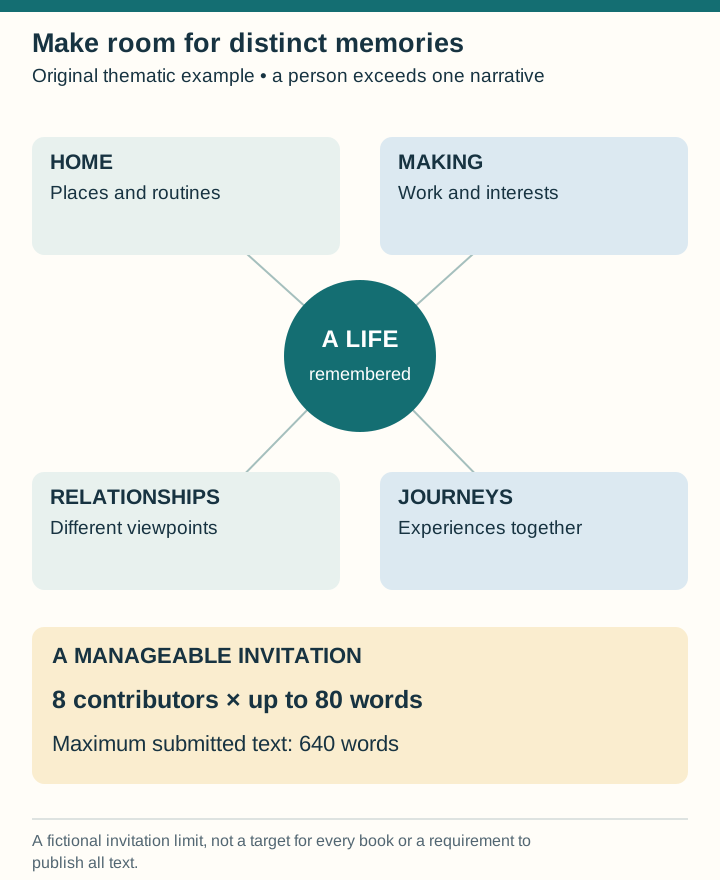
The practical challenge is editorial: photographs arrive from different periods, people remember events differently, and a printed page can make an uncertain statement appear settled. A thoughtful album lets images and attributed memories complement one another while leaving room for what is unknown or private.
Choose the audience before asking for material
A small book for close relatives may contain details that would be inappropriate in a public commemorative volume. Describe the intended use when asking for photographs or writing. “Five printed copies for the household” and “a downloadable book shared publicly” are different projects, even when they begin with the same collection.
Ask one person to coordinate the edition and another to review names and dates. Contributors can approve their own wording without every relative having to redesign every page. Set out how disagreements will be handled before the first proof becomes a contest over whose memory is definitive.
| Decision | Fictional project choice | Why it matters |
|---|---|---|
| Audience | Close family and invited friends | Guides the amount of personal context |
| Form | A short printed volume, with a private review proof | A review file is not automatically a public edition |
| Contribution size | One photograph and up to 80 words | Makes participation manageable |
| Review | Each contributor checks attributed wording | Reduces accidental changes of meaning |
Choose an organizing idea that suits the material
Chronology is useful when the photographs cover a life evenly and reliable dates are available. A thematic structure can work better when some periods have few images. Chapters about home, work, friendships, making things or shared journeys can preserve recognizable aspects of a person without inventing a complete timeline.
Do not assume a formal portrait should open the book. A photograph of someone doing something characteristic may offer a stronger introduction. The choice depends on the person and the readers, not a universal rule about memorial design.
Keep a short chronology elsewhere if it helps orientation. A page listing verified milestones can support thematic chapters without requiring every image to be precisely dated. The caption guide shows how to handle approximate periods and disputed identities.
Ask for a specific memory, not a complete tribute
A request for “something meaningful” can be difficult to answer. Offer a concrete prompt: a small act you remember, an object they used, a phrase whose context you can explain, or something they taught you. Let contributors decline or choose another subject.
Oral History Association guidance emphasizes transparency, informed participation and respect for agreed use. For this smaller editorial project, tell contributors what you intend to publish and let them review any attributed extract. A private conversation is not automatically an approved passage for the book.
- Photograph: supply the best available file or a safely handled original.
- Identification: name the people and explain any uncertain date.
- Memory: describe one event or habit in your own words.
- Use: state whether your name and wording may appear in this edition.
Keep the full contribution separately from the edited passage. Shorten repetition with the contributor's agreement; do not combine sentences from different contexts into a statement they did not make. If wording is a reconstruction rather than an exact quotation, present it as recollection or paraphrase.
Build one chapter around evidence and different viewpoints
Imagine a fictional chapter about a family member's garden. It has a photograph of seedlings, a portrait beside a repaired bench and two contributions: one person remembers patient instruction, another remembers unsuccessful tomato experiments. The chapter need not choose between those memories. Together they show work, humor and a relationship.
| Element | What it contributes | Editorial limit |
|---|---|---|
| Wide garden photograph | Shows the setting and arrangement | Does not establish who planted every bed |
| Bench portrait | Connects the person with a familiar place | Caption names only the date and people that can be supported |
| Teaching recollection | Preserves one contributor's experience | Attributed to that contributor, not the whole family |
| Tomato story | Adds a specific, different memory | Edited with permission and without embellishment |
Eight contributors supplying up to 80 words each create a maximum of 640 submitted words under that invitation. That is a collection target, not a requirement to print all 640. If two contributions describe the same incident, preserve both originals and discuss whether the book needs both full texts, two short attributed extracts or one with an editorial note.
Handle gaps without fabricating completeness
Some periods may have no surviving photographs. A short text, a clearly identified later view of a place or an image of a relevant object can acknowledge that absence. Do not label a later illustration as the actual scene it represents.
There may also be people who do not wish to contribute or difficult relationships that do not fit a celebratory account. The album does not have to resolve every family disagreement. It can state its limited scope, use neutral verified captions and omit disputed assertions that are unnecessary to the project.
For inherited material, the sorting guide helps keep source groups and uncertainty intact. Avoid permanently rearranging an old collection merely to create a smooth narrative in the new volume.
Give the reader space to look and read
Use a small number of layout patterns and readable text at the intended page size. Let a significant image occupy enough space to be understood. A page of tiny pictures may demonstrate quantity while making it hard to recognize the person or follow a memory.
A quiet page can be intentional. It should still have a role in the reading sequence, rather than filling a manufacturing gap with generic quotations. Use a real contribution, a supported caption or no additional text when that serves the material better.
Review the edition with clear boundaries
Separate fact corrections from design preferences. Check names, dates, image-caption matches and the approval of attributed wording. Then review the overall balance: are several relationships visible, and does the book preserve specific memories rather than repeating the same praise?
Use representative print proofs before ordering the final copies. Retain the contribution record, approved text and final file set privately. The finished album can be incomplete in the honest sense that every life exceeds a book, while remaining careful and complete about the material it does present.